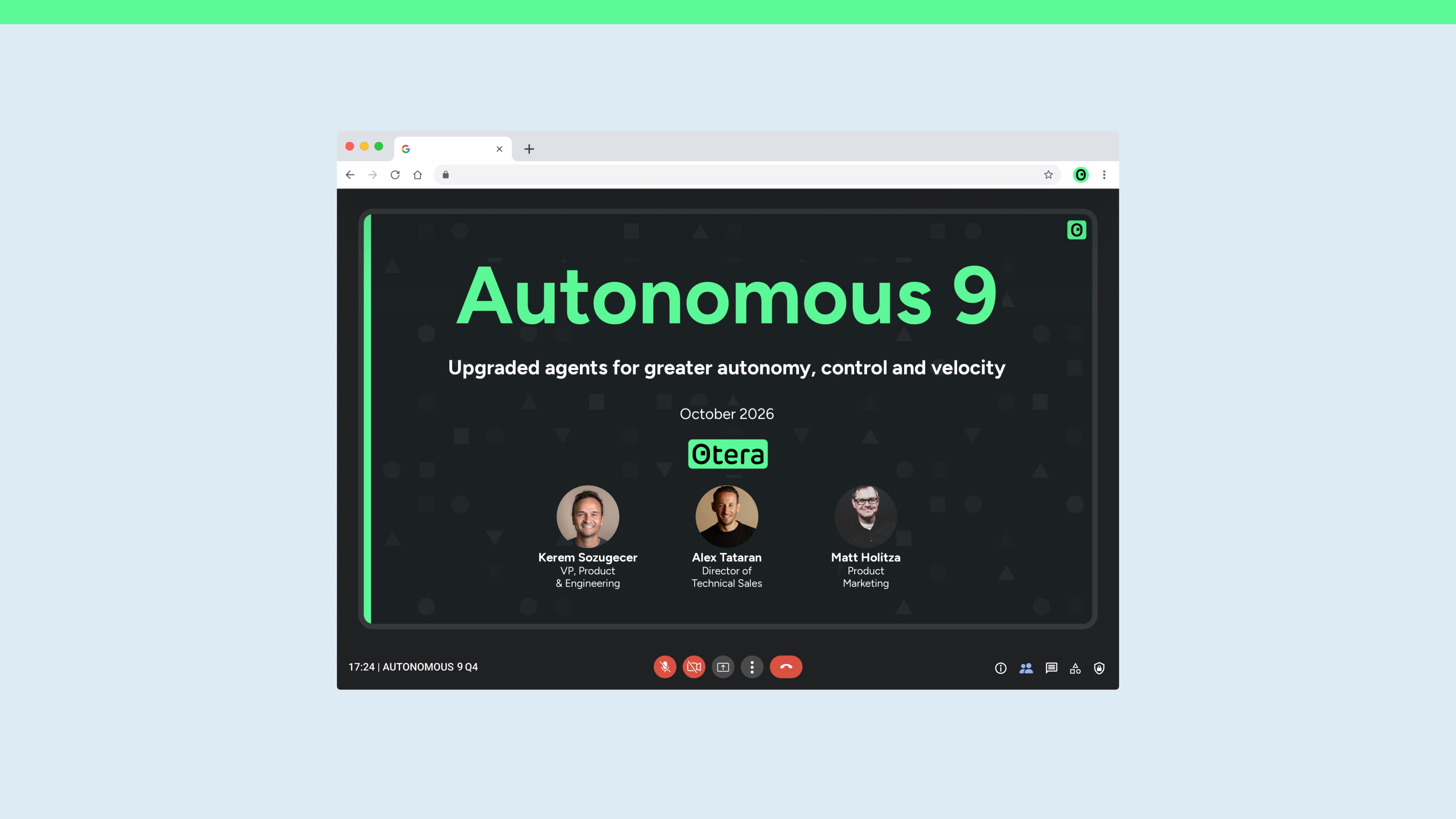


Every quarter, Otera hosts Autonomous, a customer-only product launch event where customers see what’s new in Otera Studio and what they can start using right away.
On October 28, Otera held Autonomous 9, where customers saw 2 releases: a new Base Agent for the steps that no specialized agent covers, and the Proof Agent, now generally available.
The Base Agent replaces the code between specialized agents
Otera’s agents are each built for one kind of task, such as extracting data from documents or running checks.
Complex processes also hold steps that fall between those tasks: reconciling several data sources, calculating a payout, or applying a hard-coded quoting rule.
Until now, teams usually wrote those steps as JavaScript or Python code nodes inside the workflow, which took several rounds of building and testing.
The Base Agent is a multipurpose agent for those steps. Teams give it instructions in plain language, choose how much reasoning it applies to the input, and define the output either with a JSON structure or field by field in the interface.
It selects from a set of pre-built tools to complete the task, including a calculator for steps that need exact mathematics.
“Every use case has steps that don’t fit a specialized agent. The Base Agent gives teams one agent for all of them, without writing code.”
Kerem Sozugecer, VP of Product & Engineering, Otera
The Base Agent also works alongside the Proof Agent, the second release of Autonomous 9.
The Proof Agent is now generally available
The Proof Agent reads a policy, contract, or SOP exactly as written and turns its rules into deterministic logic, formalized as an Agentic Decision Graph.
Each incoming case, such as a claim or a loan application, is then decided by that logic, and every decision cites the clause behind it.
With the Base Agent, customers now have 3 agents for decisions, each suited to a different kind of step:
These agents are the result of the last 2 years of research and engineering at Otera. The Proof Agent, for example, took around 18 months to build.
And every one of them can be fully traced in its work: the Proof Agent cites the clause behind each decision, the Check Agent explains each check, and the Base Agent’s steps show in Control Hub. Every agent’s response, including its execution trace, is written to the same data layer as the rest of the process.
They work together in one process, with each step handled by the agent built for it. And the live demo during the event showed them in action on a banking case.
Demo: an SME loan decided end to end
At the event, Alex Tataran, Director of Technical Sales, ran the demo built around a banking use case: a small family business applying for an expansion loan at a bank.
The applicant’s submission included bank statements, financial statements, a company registry extract and the loan application.
- A Document Extraction sub-agent pulled the figures from the submission and showed where each one came from in the source pages.
- The Check Agent ran 9 cross-document checks, from confirming the submission was complete to matching bank deposits against declared revenue and confirming declared debt against the bank’s own records, each with a full explanation for the audit trail.
- The Proof Agent decided eligibility against the bank’s lending policy. It checked the request rule by rule and traced each rule to its clause. One rule is a minimum of 3 years of trading history, and this business, with 12 years, met every rule.
- The Base Agent built the credit model: EBITDA, debt coverage and leverage, the loan the business could carry, its risk grade and the resulting rate.
Otera then ran all 4 steps as one process.
Once the applicant submitted the documents, the credit officer received every agent’s output, the eligibility explanation and the source documents in one view, with a recommendation to approve the loan and the final call to make.
What comes next
The team also previewed new ways to build in Otera Studio, which customers will see in the coming months.
Customers who want to try the Base Agent or the Proof Agent can contact their account team or forward-deployed engineers. Or book a demo to see the agents in action.
Next Steps: From Insight to Action
Next Steps: From Insight to Action