
The 7-Layer AI Stack for Insurance and Banking
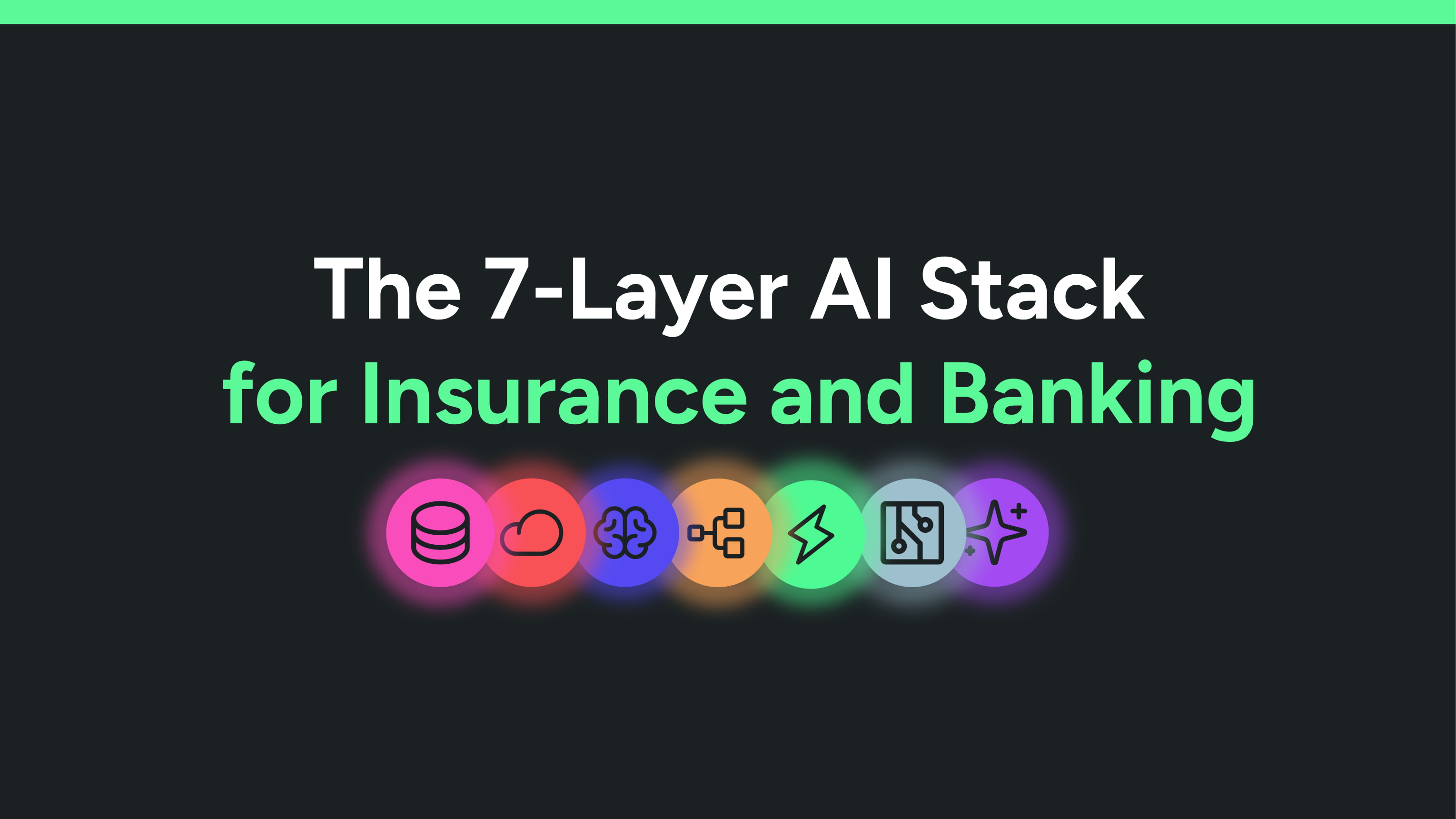


A technology leader in insurance, banking or global business services who wants operational decisions to complete without a person is building on a stack of seven layers of technology, from hardware at the bottom to decisions made end to end at the top. Examples include claims, underwriting, KYC, loan origination and accounts payable.
From that stack, four layers are almost certainly already covered by your existing contracts. And three are layers where the work is actually getting moved to machines, which is where plans need the most detail.
You should place your automation program on the stack before choosing any framework or vendor. This article walks through the seven layers, compares three ways to build them, and ends with a question to put to your own roadmap.
The stack has seven layers, and every automation program requires all of them
Every automation program needs all seven layers, so the real choice is who provides each one.
The seven layers, from hardware to autonomous decisions
- Hardware. The GPUs, data centers and model providers’ own capacity that AI runs on.
- Cloud. The compute, storage, identity, network and API gateway your security team already runs.
- AI services. Azure AI Foundry, Amazon Bedrock and Vertex AI, with their document services, give you model access under your existing contract, evaluation tooling, baseline document extraction and enterprise identity.
- Data platforms. Databricks, Snowflake and their neighbors govern data, host features and vectors, and run pipelines.
- Agent frameworks. LangGraph, Semantic Kernel, Copilot Studio, or the glue code a coding agent writes in an afternoon, let you define agents, tools and flows.
- The operations layer. The decision logic your operation runs on, the interface where staff review and correct decisions, the record every verdict is written to and the audit trail. It also holds the roles and permissions that decide who sees what, including role-based access and single sign-on, and the analytics and monitoring that show how decisions perform.
- Autonomous decisions. Claims, underwriting, KYC, loan origination or procurement decided end to end, at volume, to a standard an auditor accepts.
The first four layers are usually already in your contracts, and no roadmap should rebuild them.
Three ways to build the stack: build, assemble or adopt
There are three paths to the full stack, and they cover every option. All three reach the same top, autonomous decisions made end to end at volume, to a standard an auditor accepts. What differs is who provides each layer and what your team owns afterwards.
- Build the foundation. Start at the AI services or a data platform, add a framework and build everything above it, including the operations layer. You own the codebase and the team that maintains it.
- Assemble it. Start at the agent frameworks and add specialized components from several vendors, stitched into a whole you design. You own the design and the seams between components.
- Adopt an operations layer. Start at the layer that already carries decision logic, review, record, audit and roles, and build your use cases on it. You own your logic, your decisions and your data, while the foundation is someone else’s.
By Otera’s engineering analysis, a first production decision takes 18 to 30+ months when you build, grows with every component when you assemble, and takes 6 to 12 weeks on a mature platform when you adopt. A separate article will compare the three paths in more detail.
For your CIO, the first job is to list what each existing contract gives you at the operations layer, and the usual answer is identity and nothing else.
The question that sorts every roadmap is: “Which layer does our design start at, and who owns every layer above it?”
For business leaders, the equivalent is to ask, whenever a program is funded, which layer the money is actually buying.
The operations layer turns agents into an operation
The operations layer holds six things: decision logic that’s executable and versioned, the interface in which operations staff review and correct decisions, and the decision record every verdict is written to. It also holds the audit trail, the roles and permissions (including role-based access and single sign-on) that decide who sees what, and the analytics and monitoring that show how decisions perform.
It’s the layer most first-year plans for autonomous operations don’t contain, and it stays the same whichever starting point you choose.
The table shows where four common starting points are strong and what still sits above them.
Each of these is a good starting point.
The right-hand column is the operations layer, and it’s the same whichever one you pick.
A roadmap for autonomous operations that funds AI agents and frameworks and treats decision logic, review, audit and roles as “phase two” has funded the middle of the stack and called it the top.
To realize everything that has to happen above these starting points, and to reach business value fast, the strongest move is to adopt an operations layer instead of building or assembling one.
As the comparison of the three paths shows, building takes the longest route to a first production decision, and assembling moves the work into the seams between components.
Adopting starts you at the operations layer, with decision logic, review, record, audit and roles already in place, so your team builds use cases instead of infrastructure and the time to business value shrinks.
A document service is enough when nobody will ask why a decision was made
Not every process needs the operations layer.
If the process is a single stage, the volume is low, a person reviews every case by design, and nobody will ever be asked to prove why a decision was made, then a document service and a workflow tool are the right answer.
The operations layer earns its cost when cases must complete without a person, at volume, to a standard someone will audit. If that isn’t your situation, stop at the lower layers.
Mark your roadmap against the seven layers
If you want a first move, take your current roadmap for autonomous operations, mark each item against the seven layers, and see whether anything sits on layer 6.
If nothing does, you’ve found the work that stands between your agents and an operation that runs on its own.
Agents on the first five layers can read a document and draft a decision. Agents on all seven can make that decision, show the evidence behind it, and leave your team able to change the logic when the business changes.
Next Steps: From Insight to Action
Next Steps: From Insight to Action