
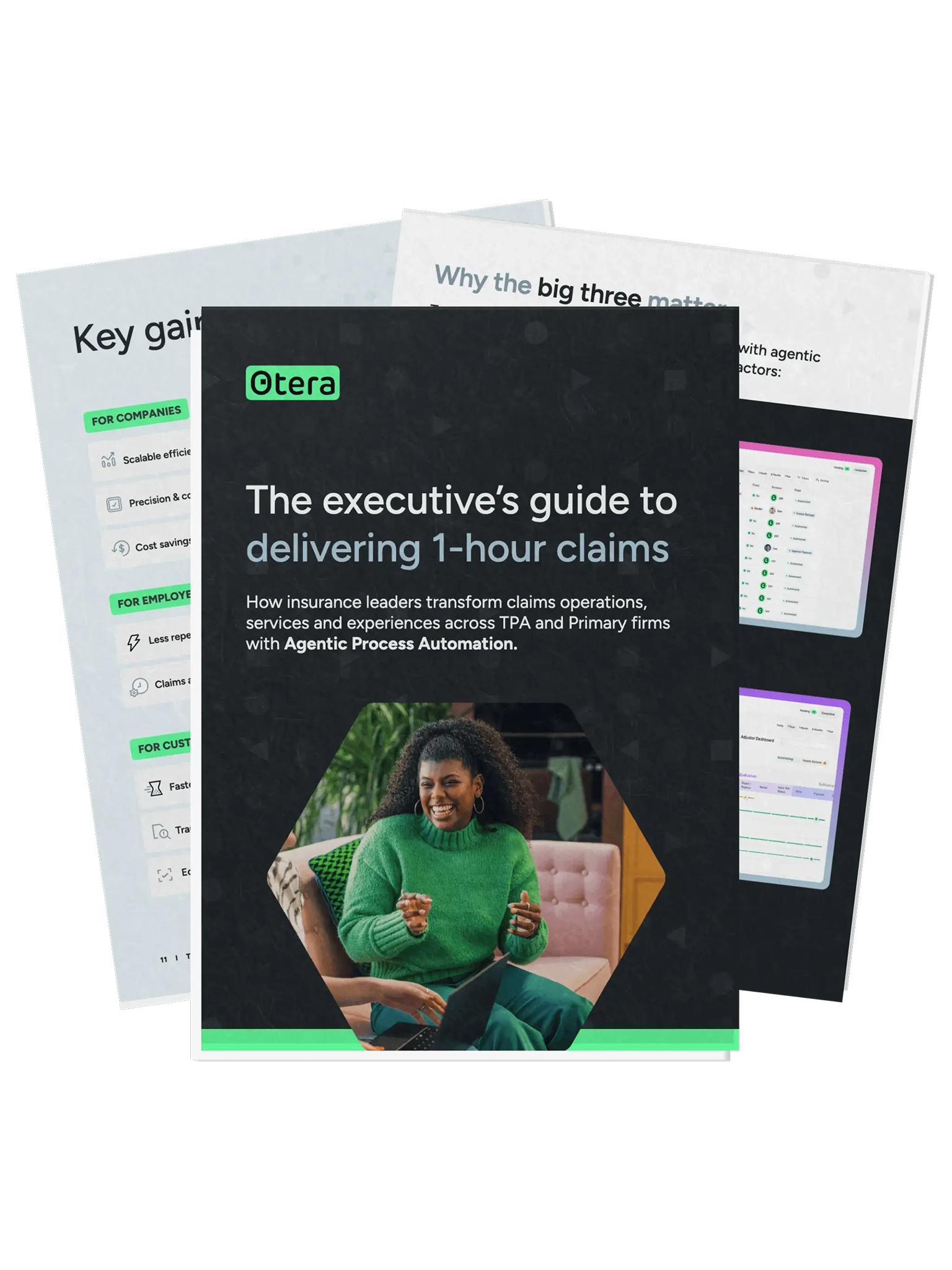
The executive’s guide to delivering 1-hour claims

The specific framework insurers used to move from manual, human-at-every-step claims operations to autonomous execution
A step-by-step claims process map showing exactly where autonomous agents act and where humans still need to
Why most enterprise AI projects never reach production and what separates the ones that do
This whitepaper breaks down the operating model behind 1-hour claims, the three levers that drive it, and the four insurers already running it in production.




.avif)




What’s Inside The Executive’s Guide to Delivering 1-Hour Claims
The framework, the process map, and what separates the 5% of AI projects that reach production from the 95% that don't.
The Five Barriers Standing Between You and 1-Hour Claims
- Talent shortages, regulatory pressure, financial volatility, and fragmented systems
- Processes that still require humans at every step
The Three-Lever Framework Behind Autonomous Claims
- A specific framework that changes how claims operations generate profit
- Each lever broken down with production evidence
- What the same model would mean for your operation
Four Case Studies from Insurers Running This Today
- Allianz Partners, CED, Uelzener, and a top-five European insurer, different paths, same destination
- Each faced different constraints. All reached production.
- Their timelines, results, and the deployment decisions that made the difference
Testimonials

We gained a lot of time in our back office, 80% of our staff was able to reallocate their time. The transformation happened faster than anyone expected.

With the advancements in language models and automation, we finally have the tools to create that backbone, using Otera to bring best-in-class agents, tools, control and workflows into our operations.

Key results
Claims resolution in minutes, not weeks
Reduction in operational costs
Month in production , not quarters

Featured in This Whitepaper
Allianz Partners
Their previous automation investments hadn’t delivered the transformation they needed. What they built next became the world’s largest autonomous operations deployment.
CED
600,000 annual emails were creating bottlenecks. Previous solutions had fallen short. See what changed.

Uelzener
A specialty insurer whose team went from AI skepticism to enthusiastic adoption. The whitepaper explains how.

Fortune 500 Insurer
500,000 annual claims across five lines of business and five countries. They replaced their previous automation investment entirely.
Get the executive’s guide to delivering 1-hour claims
Every insurer in this whitepaper had already invested in automation before reachingOtera. This guide shows what changed, what they deployed, and the specific results they are seeing in production. It also includes a step-by-step claims process map and a deployment strategy framework from a Group CIO.
.webp)
.jpg)