
How a Swiss Insurer Built Claims Operations That Scale with Any Crisis


A claims operation built for normal times breaks during every crisis. The question isn’t whether a flood or storm will overwhelm the team, it’s whether the operation is designed to absorb that pressure or buckle under it. One of the world’s leading insurers decided to answer that question by replacing its manual claims model with autonomous operations. The result is an operation that now scales to any volume, in any market, without adding headcount.
This video tells that story:
The structural problem every large claims operation hits
This major Swiss insurer processes millions of cases per year across multiple countries. That scale exposes four structural tensions that traditional automation cannot resolve:
- Volume and volatility. Storm seasons and mass damage events arrive without warning, precisely when response speed matters most. The operation that handles 10,000 cases a week needs to handle 100,000 without degrading.
- Regulatory and product complexity. A motor claim in Spain and a liability dispute in Germany require different rules, different languages, and different product-line logic. Uniform precision across all of them is not optional.
- Linear cost scaling. When more cases required more people, margin expansion hit a structural ceiling. The growth model and the cost model were locked together.
- Decision quality under pressure. Whether at normal capacity or in the middle of a crisis, every claim required a consistent, auditable outcome. That standard does not flex.
Legacy automation could not solve this. Judgment calls, cross-referencing, and end-to-end execution from first notice of loss through settlement and payment still fell to human teams. When a crisis hit, the backlog grew faster than any team could clear it.
Autonomous agents running claims end-to-end
The insurer took a different approach with Otera. Rather than layering automation tools on top of the existing model, they deployed autonomous AI agents that now run claims operations end-to-end.
When a customer reports storm damage through their portal, specialized agents immediately take over: one validates the policy, another assesses the damage, another cross-checks against fraud patterns. These agents collaborate to settle the claim, trigger payment, and notify the customer… all in real time.
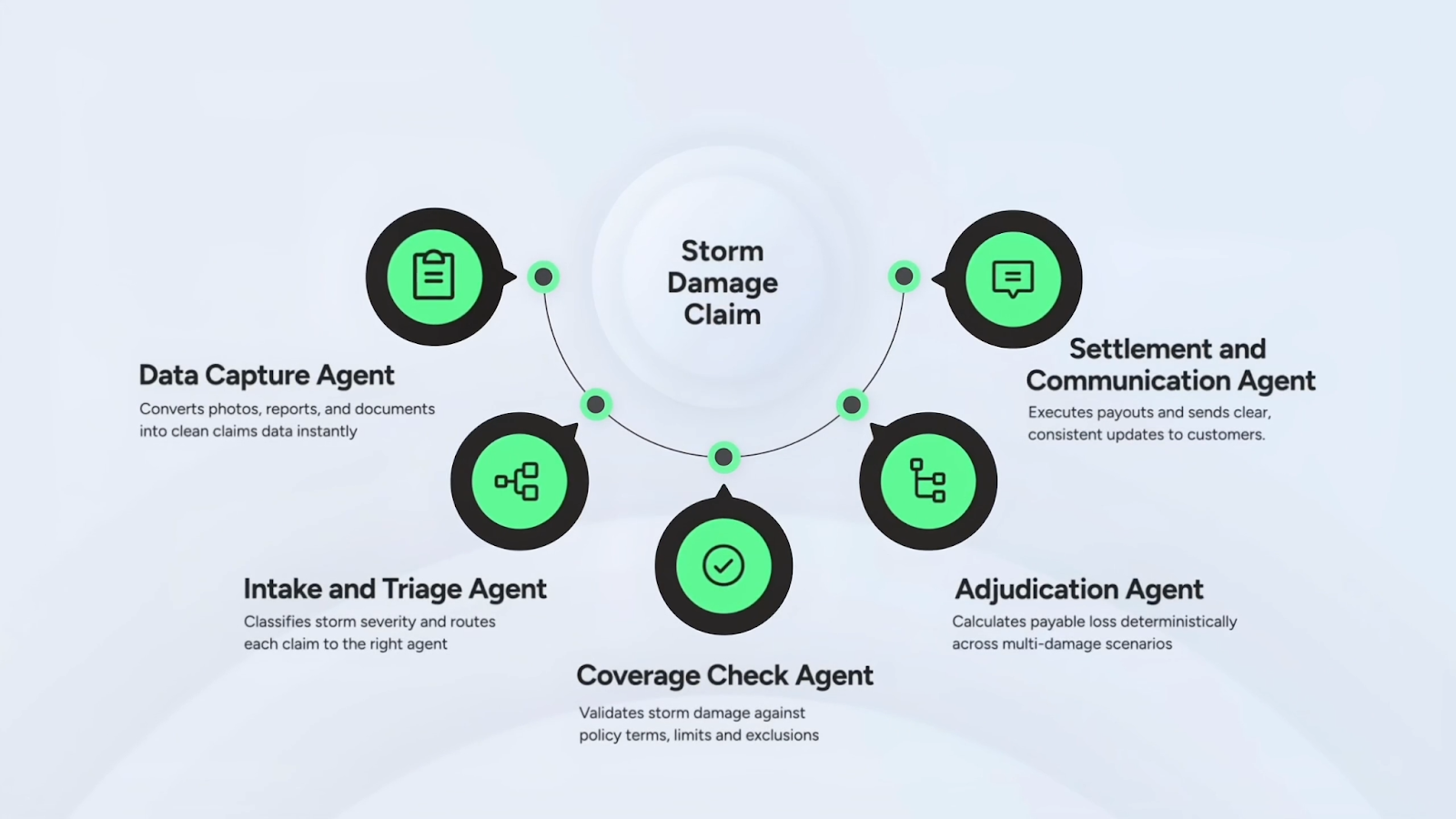
Human teams step in only for genuine edge cases that require judgment and empathy. Everything else flows straight through.
An new operating system, not a point solution
What this insurer built is not a one-off automation project. It is an operating system that scales with demand regardless of what that demand looks like.
The shift shows up differently for each stakeholder:
- For policyholders, a claim filed after a storm no longer enters a queue measured in weeks. Resolution arrives immediately. That is the difference between a company that processes your claim and one that is there when you actually need them.
- For claims teams, the daily work shifts away from classification, data entry, and routine settlements toward the cases that genuinely require judgment: complex disputes, sensitive situations, fraud investigation.
- For the organization, a mass damage event no longer triggers emergency hiring and months of backlog recovery. The operation absorbs the spike.
The architecture is not scoped to one product line or geography. The same autonomous agents that settle a storm damage claim in one market run motor, liability, and health claims across entirely different regulatory environments. That composability is what separates an operating model from a point solution: a point solution fixes one workflow, Otera changes how the entire claims organization runs, from this quarter forward.
This is the shift underway across the industry: from claims operations constrained by how many people you can hire, to operations that scale with demand. The insurers pulling ahead are not the ones automating faster. They are the ones that stopped automating and started operating autonomously.
Next Steps: From Insight to Action
Next Steps: From Insight to Action

.svg)

.jpg)