
State of Process Automation Live Session: AI Hype vs. Business Value
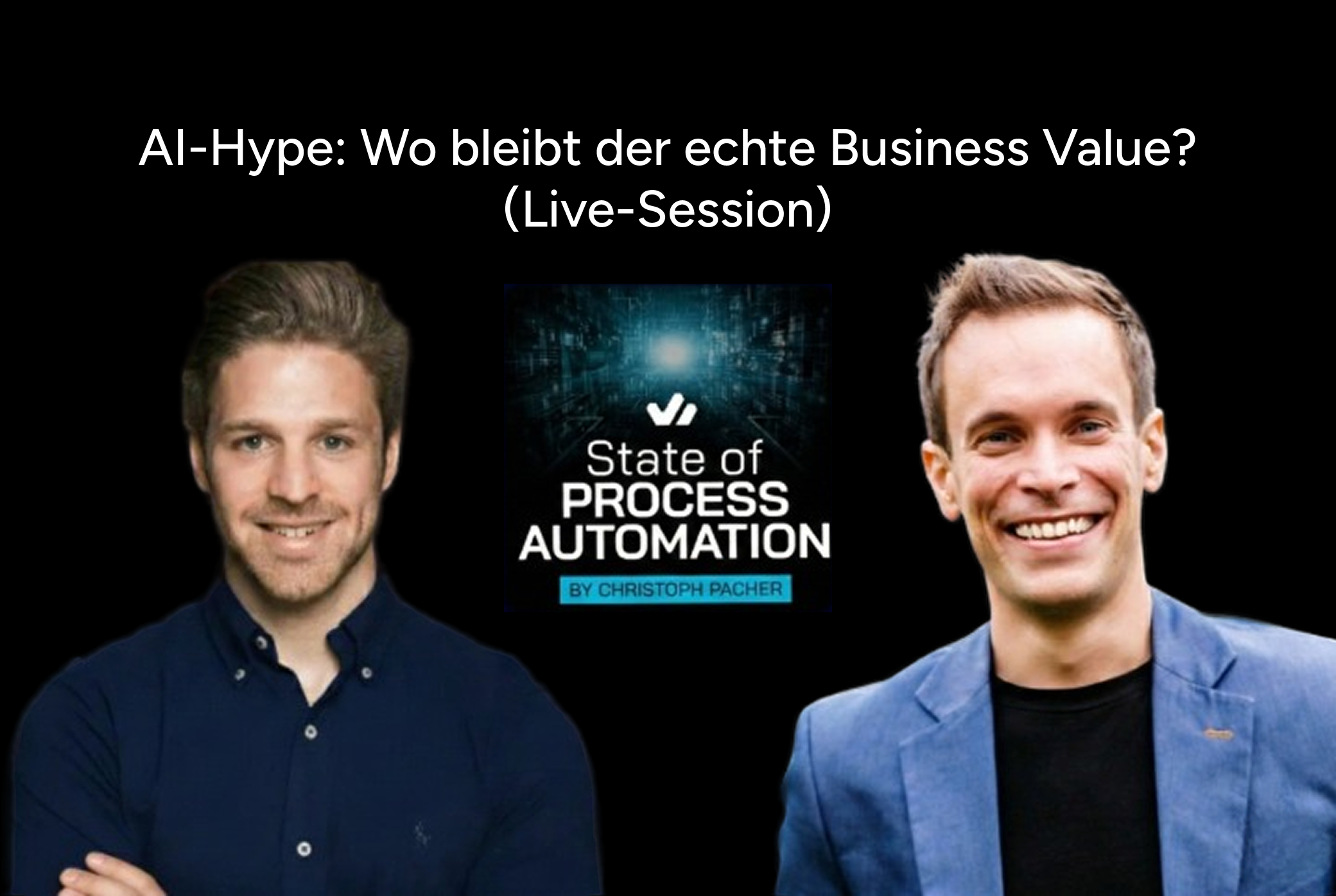

Most enterprises now accept that generative AI will reshape operations. The harder question, and the one that separates leaders from followers, is where it delivers measurable impact at enterprise scale and where it remains an expensive experiment. Earlier this month, the State of Process Automation podcast brought together practitioners to pressure-test the hype with operational reality.
Hosted by Christoph Pacher, founder of State of Process Automation, the session featured Stefan Engl, CEO and Co-Founder of Otera (previously DeepOpinion); Enver Cetin, Senior Manager Intelligent Automation at Ciklum; and Pedro Berrocosso, Founder and Senior Advisor at AccelerIQ GmbH. The conversation moved past surface-level enthusiasm for AI and into the operational foundations that determine whether a deployment generates tens of millions in value or stalls at the proof-of-concept stage.
"Generative AI has great power, which one should use. One needs certain frameworks around it, so that it doesn't produce more issues, but one can actually produce valuable results with it today." Stefan Engl, CEO and Co-Founder of Otera
Key Takeaways
• Governance determines outcomes, not the model itself.
The panel agreed that enterprises fail to capture value not because the underlying AI is inadequate, but because they deploy it without the operational guardrails to make it reliable. In high-stakes, regulated environments, ungoverned AI generates risk faster than it generates returns.
• Terminology confusion stalls executive decision-making.
Panelists discussed how imprecise language across the industry makes it harder for senior leaders to evaluate vendors, set realistic expectations, and distinguish genuine autonomous capabilities from incremental automation wrapped in new branding.
• Readiness work is not optional.
Organizations that rush to deploy generative AI without first addressing data quality, process clarity, and organizational alignment consistently underperform. The panel emphasized that the companies achieving the largest results treat operational readiness as a prerequisite, not a parallel workstream.
• The highest-impact use cases involve end-to-end process transformation.
Organizations seeing the greatest returns are not automating isolated tasks. They are rethinking entire operational workflows, particularly in document-heavy, decision-intensive processes where the gap between manual operations and autonomous execution is widest.
• Regulated industries are leading, not lagging.
Insurance, banking, and government were highlighted as sectors where generative AI is delivering the most tangible business impact today, precisely because the complexity and volume of their processes create the conditions where autonomous operations unlock the most value.
Timestamps
• (00:01) Introduction to the live session and the topic of AI hype.
• (04:06) How the guest speakers perceive the AI hype and define key AI terms.
• (14:20) Why ChatGPT results are getting worse and challenges with the technology.
• (16:44) Homework companies must do before implementing AI and mistakes to avoid.
• (41:48) Use cases where generative AI is observed to bring the most value.
The full conversation is available on the State of Process Automation podcast and is well worth the time for any operations or technology leader evaluating where AI fits within their enterprise operating model. Find it here.
Next Steps: From Insight to Action
Next Steps: From Insight to Action

.svg)

.jpg)