
Otera crowned winner of ADIB’s industry-shaping Innovation Programme
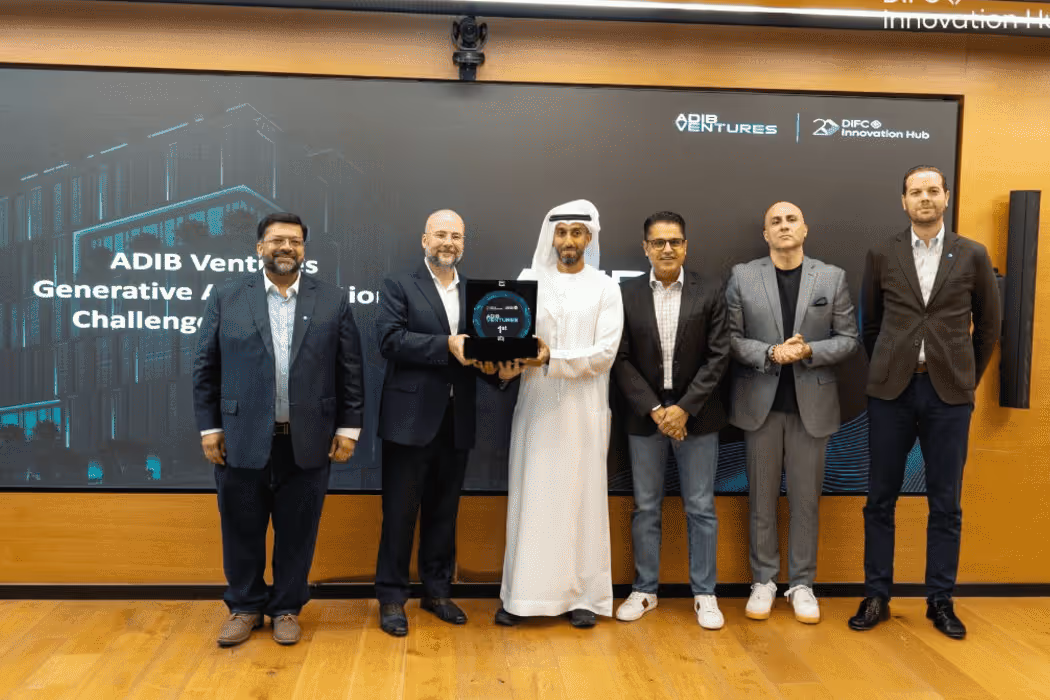

When a $34-billion Islamic bank evaluates 60 technology vendors across three continents and selects one, it is not a procurement decision. It is a signal of which operating model the next generation of banks will run on. Abu Dhabi Islamic Bank (ADIB) ran that evaluation through its Innovation Scouting Programme and selected Otera as the winner, choosing autonomous operations over 59 alternatives.
A Rigorous, Real-World Evaluation
ADIB's programme moved through three stages. Sixty vendors entered. Internal committees assessed each against a clear bar: could the solution fundamentally change how the bank operates, not just digitize what already exists, while meeting the governance and compliance demands of a regulated Islamic finance institution? Six finalists presented to roughly 30 senior leaders, including five C-level executives.
The other finalists spanned the UAE, Europe, and the United States, each offering capable technology. What separated Otera was an operating model distinction. Where other solutions proposed to make existing processes faster or more accurate, Otera demonstrated how specialized AI agents could execute core banking workflows end-to-end, with humans setting governance rules and intervening only where genuine judgment is required.
"ADIB evaluated 60 vendors and chose autonomous operations. That tells you where banking is heading. Not toward better tools, but toward a fundamentally different way of running the institution," said Stefan Ramershoven, CRO of Otera.
Addressing Core Challenges in Modern Banking
Banks operating at ADIB's scale carry enormous process complexity. Compliance verification, document-intensive onboarding, multi-party exception handling, internal reporting across jurisdictions. Traditionally, these workflows run on large operational teams supported by fragments of automation that still leave humans to reconcile gaps, chase exceptions, and make judgment calls at every decision point. The process stays fundamentally manual. The cost stays fundamentally fixed.
Autonomous operations replace that model entirely. Specialized AI agents collaborate under governance to handle the full process from intake to resolution. Humans define the rules, monitor outcomes, and step in where the situation genuinely demands human judgment. Everything else runs without manual intervention. For institutions processing millions of transactions across multiple countries, this is a structural shift in operating capacity and cost, measured in the hundreds of millions over a transformation cycle.
A Milestone for the Banking Industry
ADIB's decision carries weight beyond its own operations. Regulated financial institutions have historically moved cautiously on automation, and for good reason. The processes that matter most are the ones full of exceptions, regulatory nuance, and multi-system complexity. These are exactly the processes that previous generations of automation tools could not touch.
That barrier is what makes ADIB's selection significant. This is a bank with over one million customers, more than 60 branches, and operations spanning six markets choosing to move from assisted automation to autonomous operations. Other institutions evaluating their own transformation programs now have a reference point. The question is no longer whether autonomous operations can work in regulated banking. It is how quickly the rest of the industry will follow.
About Abu Dhabi Islamic Bank (ADIB)
ADIB is a leading Islamic bank headquartered and listed in Abu Dhabi, UAE. The bank holds $34 billion in assets and serves over one million customers across more than 60 branches in the UAE, with a presence in six strategic markets including Egypt, the Kingdom of Saudi Arabia, the United Kingdom, Qatar, Sudan, and Iraq.
Next Steps: From Insight to Action
Next Steps: From Insight to Action

.svg)

.jpg)