
How Allianz Partners are Replacing Manual Claims Operations with Autonomous Agents
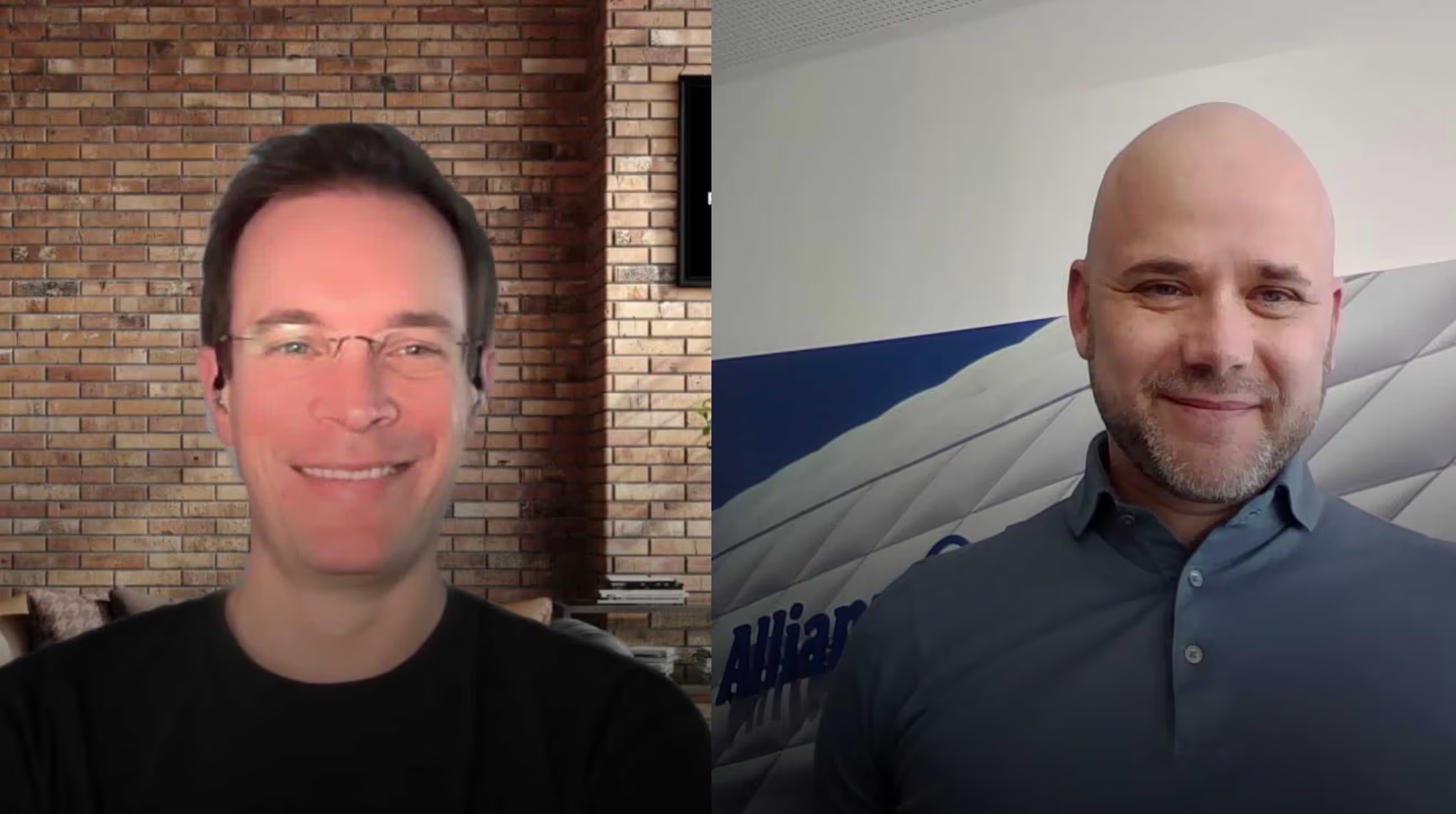

Stefan: Can you tell us about your role, goals, and this collaboration?
Pieter: We're a leading brand in the assistance business, operating across North America, South America, Europe, and Asia. One of our biggest structural challenges is that over the years, we've acquired multiple companies, each with its own legacy systems. We never had a unified operational backbone.
With the advancements in language models and autonomous agents, we finally have the means to build one. We started with the decisions that drive our operations, working with Otera (previously DeepOpinion) to redesign how work actually gets done.
This isn't about making the old process a bit faster. We're moving to a model where specialized agents handle the work end-to-end and our people govern outcomes rather than process paperwork. We make thousands of decisions every hour across the globe, and the goal is for that entire decision layer to run autonomously, with humans intervening only where real judgment is required.
Stefan: What challenges did you face in claims and why did you start this project?
Pieter: Claims was the obvious starting point because of its scale and cost. We employ large teams across multiple lines of business, each handling claims with significant variability and inconsistency. The operational spend is substantial.
But the deeper issue wasn't just cost. It was that the operating model itself was manual at its core. Every claim required a person to interpret documents, make a coverage decision, and push it forward. Multiply that across hundreds of thousands of cases per year, across geographies, and you have an operation that can't scale without scaling headcount proportionally.
What we needed wasn't a tool to help handlers work faster. We needed to fundamentally change who, or what, does the work. That required a partner with deep domain knowledge in claims, not just technical capability in language models.
Stefan: Do you see increased customer experience and competitiveness, what value is being delivered?
Pieter: The biggest shift is in decision quality. When agents handle claims decisions under governed rules, every case gets the same rigor, regardless of which country it originates in or which team would have previously handled it.
That consistency has real downstream effects. It reduces the regulatory exposure that comes from inconsistent handling. It improves the experience for customers who previously sat in queues while humans worked through backlogs. And it removes the operational stress that comes from asking people to make high-volume, high-stakes decisions all day.
Stefan: Why did you move beyond technologies like RPA and document processing point solutions, toward end-to-end autonomous operations?
Pieter: We've used automation tools before, and the honest assessment is that they solved narrow problems. You could apply RPA to move data between systems. You could use a document processing tool to extract fields. But the process itself remained manual. Humans still had to stitch everything together, chase exceptions, and make the actual decisions.
We didn't want marginal efficiency gains. We have large-scale global operations, and the question was whether we could change the operating model entirely. Could agents handle the full lifecycle of a claim, from intake through decision to settlement, without a human touching it unless something genuinely required judgment?
That's a fundamentally different ambition than applying a bot to a step.
Stefan: What have you been able to achieve so far and what’s next?
Pieter: We've gone live with autonomous travel claims operations, and we're about to go live with invoice automation.
The next phase is replication. What we've built works. The question now is how quickly we can extend it across our geographical regions and additional lines of business. The architecture is designed for that. We're not rebuilding from scratch each time.
Stefan: How does Otera integrate into existing infrastructure, what are important factors?
Pieter: The system of record stays in place. That's important because we, like most large insurers, run on legacy core systems. Otera doesn't replace them. It interfaces with them through APIs, sitting alongside the existing infrastructure and handling the decision layer autonomously.
The second critical factor is governance. Our operations teams don't process claims anymore in the areas where agents are live. They monitor, set the rules, and intervene on genuine exceptions. We've worked with Otera to build that oversight model so that the people closest to the operation retain full visibility and control over how agents perform.
We're also seeing the flexibility of language models open up new possibilities, allowing us to handle a broader range of questions and scenarios than rigid rule-based systems ever could.
Stefan: How does DeepOpnion ensure secure, scalable and compliant Agentic Process Automation in an enterprise environment?
Pieter: From a security and privacy perspective, we were confident in Otera from the start because they understood our constraints. The first requirement was a secure environment for data exchange, and that was established early.
On privacy, the non-negotiable is that we operate within established processes that customers are aware of, whether under legitimate interest or with explicit consent. Otera's setup made that straightforward. The compliance and data handling frameworks were in place from day one, and the integration between our backend systems runs cleanly.
For any enterprise operating in regulated industries, this is table stakes. If you can't demonstrate governance and auditability from the start, nothing else matters.
Stefan: Are there any best practices you can share that you've learned so far in the collaboration?
Pieter: The single most important factor is product and service ownership. When you move to autonomous operations, claims handling becomes a permanent, governed service. You need people who understand both the insurance domain and the technology, and who take long-term ownership of how the agents perform.
That combination of skills is the hardest to source. You also need strong programme management, especially at our scale, and engineers who understand how to maintain and monitor decision flows in production.
But beyond skills, the biggest accelerator has been organizational willingness. Our senior leadership understands this isn't a technology experiment. It's an operating model change. We're progressing as fast as we are because the full leadership team is aligned and committed, not just the digital team, not just operations, but the entire company working toward the same outcome.
About Otera
Otera brings autonomy to the operations the world depends on. We transform mission-critical processes into governed AI systems that decide and act end-to-end, freeing enterprises to grow without limits. Trusted by Allianz, Siemens, Bayer, SAAB, and Hannover Re.
Next Steps: From Insight to Action
Next Steps: From Insight to Action

.svg)
